
Mississauga Short-Term Rental Licence: Rules and 6 Steps
You are heading away for a few weeks this winter and your home will sit empty. Before it goes on Airbnb, here is what the City of Mississauga needs from you, and the one slow step to start today.
An empty home and a simple idea
Maybe it is a long trip south. Maybe it is a work contract out of town. Either way, your house in Mississauga will be quiet for a while, and a friend tells you they rented theirs on Airbnb while they were away.
It sounds easy. Take some photos, write a listing, open the calendar. Then you read the City of Mississauga licence page and the easy part stops.
What slows a Mississauga licence down
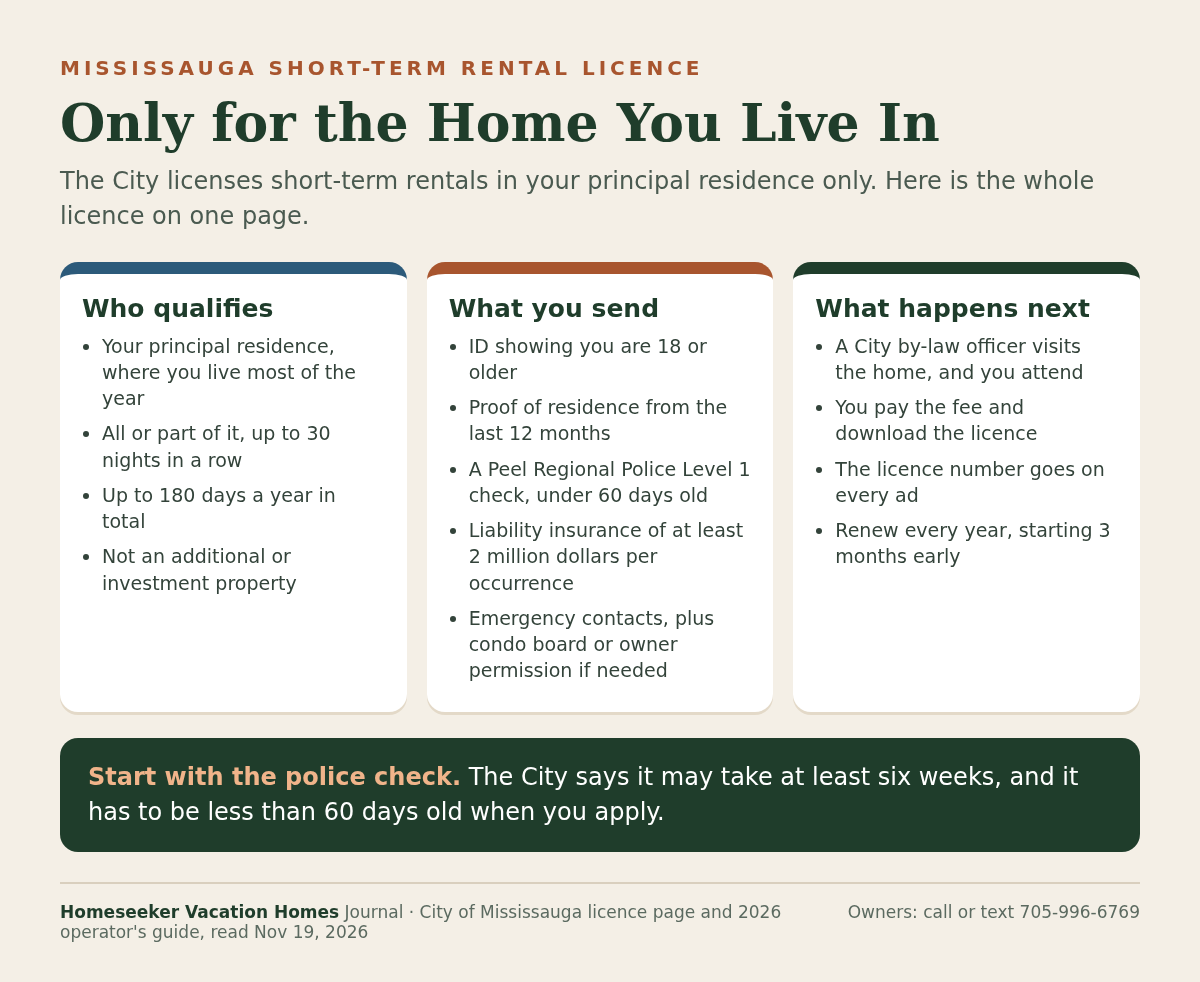
The first surprise is who can get a licence at all. The City says a short-term rental licence can only be approved for a place you live in. You can rent all or part of your principal residence, for no more than 30 days in a row and up to 180 days a year. You can't get this licence for additional or investment properties.
The second surprise is time. The City only accepts a Level 1 criminal record check from Peel Regional Police, and it says the check may take at least six weeks. That check also has to be issued in the last 60 days when you apply. After that, a City by-law officer visits the home, and the City's 2026 short-term rental operator's guide says you have to attend yourself. Nobody can go in your place.
And listing early is not a shortcut. The operator's guide says advertising without a licence breaks the by-law, and the City says operating without one can bring fines of up to 100,000 dollars.
Plan backwards from your first guest
Filling in the application is quick. The police check can take at least six weeks, and the City's operator's guide says the licensing process can take up to a month or more.
Count back from the day you want your first guest. Order the police check first and gather everything else while you wait.
Mississauga short-term rental licence: 6 steps in order
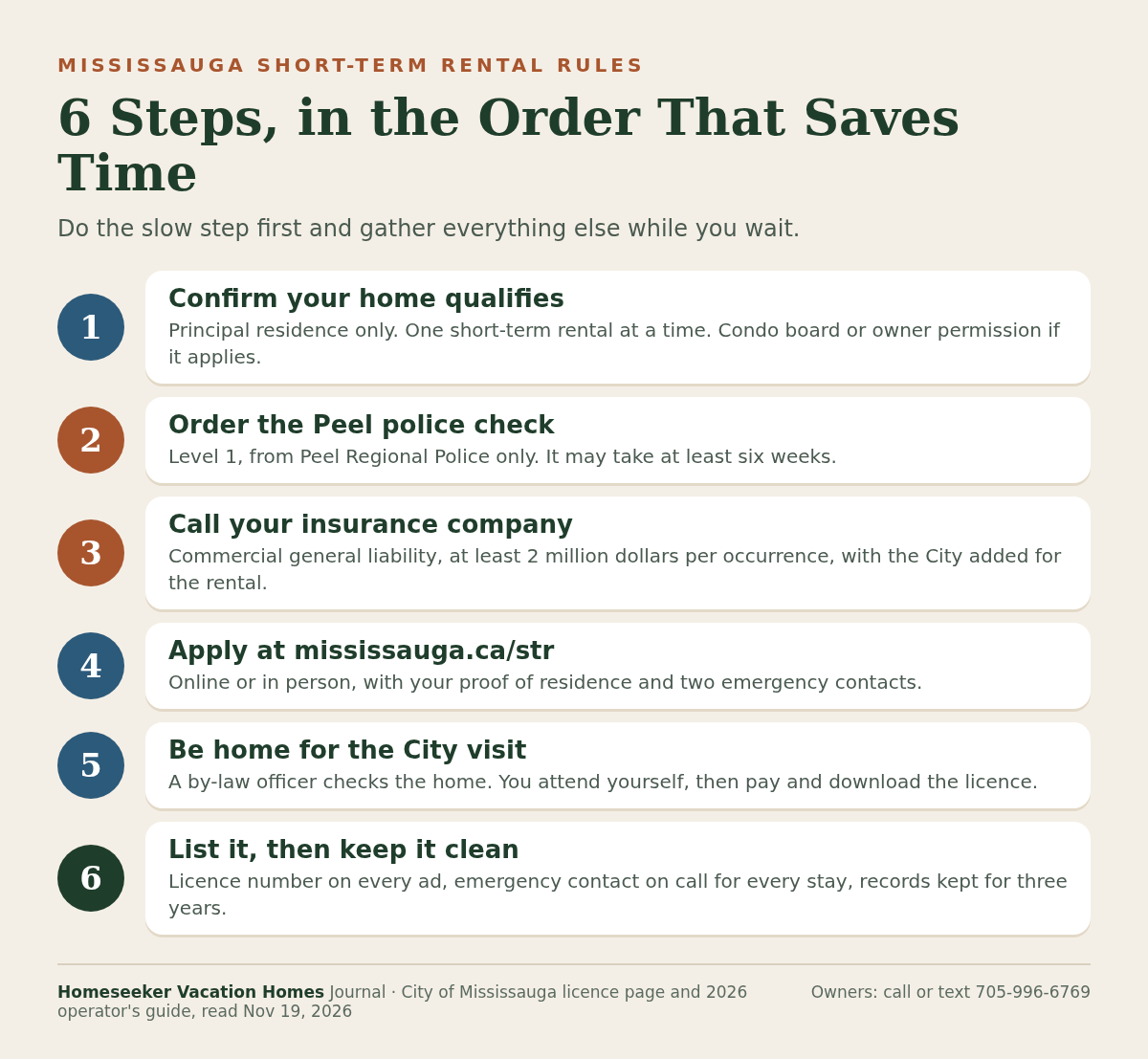
1. Confirm your home qualifies
It has to be your principal residence: the home where you live for most of the year and get your utility bills or tax documents. The guide adds that you can only advertise and operate one short-term rental at a time. Live in a condo? You need proof of the condo board's permission. Renting your home? You need the owner's written permission, and you still have to meet your lease and the Residential Tenancies Act.
2. Order your Peel Regional Police check first
This is the slow one, so it goes first. The City wants a Level 1 criminal record check from Peel Regional Police only. Checks from the OPP, the RCMP or a third party are not accepted. The City suggests applying online, and the check has to be less than 60 days old when you submit your application.
3. Call your insurance company
The City asks for proof of commercial general liability insurance with a limit of at least 2 million dollars per occurrence, and the City has to be added to the policy for the rental's operations. The guide suggests asking your insurance company about the right product for a short-term rental. A letter from them or a copy of the policy works as proof.
4. Apply online or in person
Apply through the City's short-term accommodation licence page or in person at the City's licensing office. Along with the police check and insurance, you send proof you are 18 or older, proof the home is your principal residence, such as a utility bill or tax document issued in the last 12 months, and contact details for you and a second emergency contact.
5. Be home for the City's visit
Once you apply and meet the conditions, a by-law officer visits the home to make sure it meets City standards. You attend in person. When the home passes, the City emails you to pay the yearly licence fee and download your licence. Check the City's page for the current fee, because fees can change.
6. List it, then keep it clean
Your licence number goes on every print and online ad for the rental, as the City's operator resources page says. Then the hosting rules start.
Mississauga short-term rental rules while you host
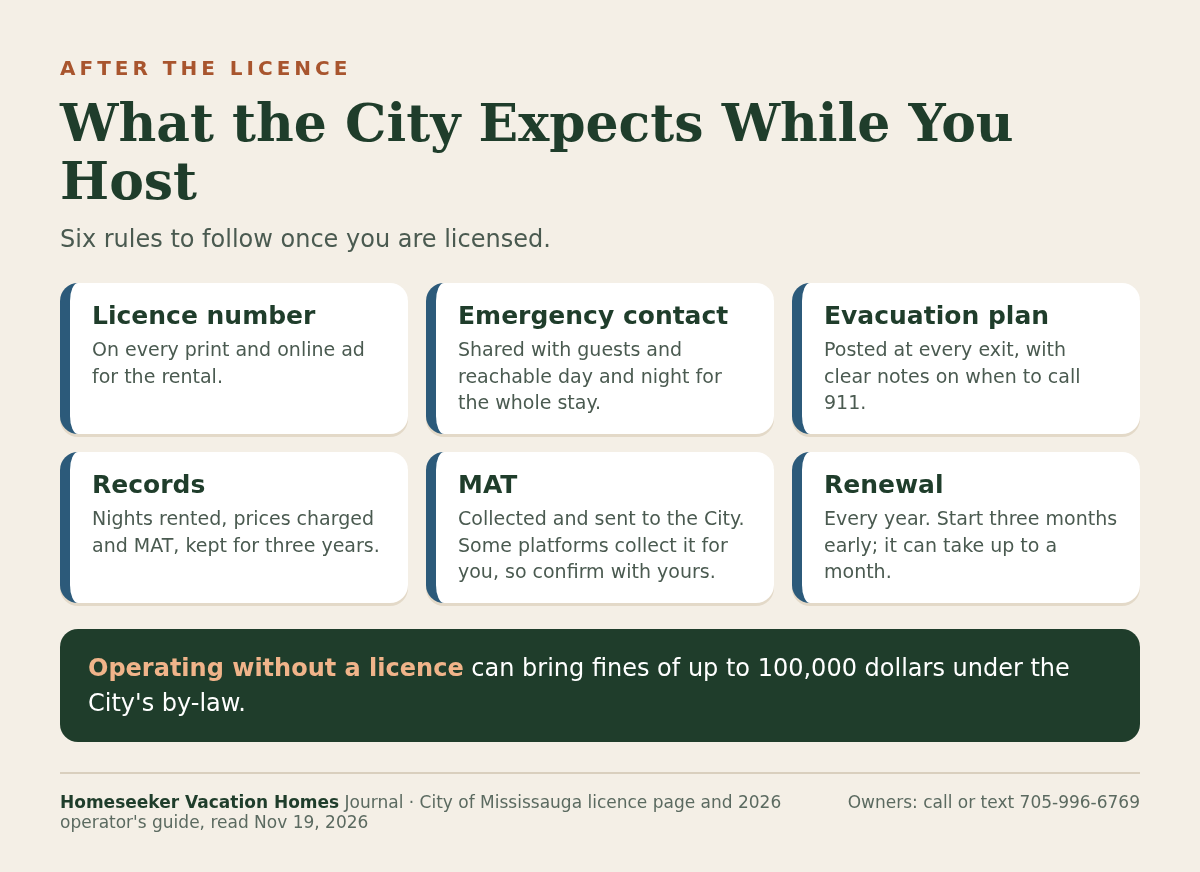
The operator's guide lists what the City expects once guests arrive:
- An emergency contact for every stay. Give guests the emergency contact you listed on your application. That person has to be reachable day and night for the whole stay.
- An evacuation plan at every exit. The by-law requires it, and the City also recommends clear notes inside the home on when to call 911.
- Records for three years. Keep the nights rented each year, the nightly and total price for each stay, the Municipal Accommodation Tax (MAT) charged and whether it was the whole home or part of it.
- MAT on every stay. Licensed hosts collect and send MAT to the City. Some platforms collect it for you, so the City says to confirm with yours. If you also host in Toronto, our guide to the Toronto MAT report walks through that city's version.
- A yearly renewal. The licence lasts one year. The City recommends starting the renewal three months before it expires, and says renewal can take up to a month.
Hosting also means answering guest messages at night, booking cleans between stays and keeping the calendar under the 180-day limit.
If you would rather have help with guest messages, cleans and the calendar, Homeseeker co-hosts city homes in the Greater Toronto Area and manages cottages in Muskoka, Parry Sound, Georgian Bay and Lake Simcoe. See our Toronto Airbnb management page, or call or text 705-996-6769.
When the property is not your home
What if the place you want to rent is not where you live? In Mississauga, you cannot license it. The licence is only for your principal residence.
Many owners in the Greater Toronto Area look north instead. In cottage country, each town or township sets its own short-term rental rules, and many have their own licence. Our Muskoka Lakes short-term rental licence rules, Huntsville short-term rental licence guide and Gravenhurst short-term rental licence guide cover three of them.
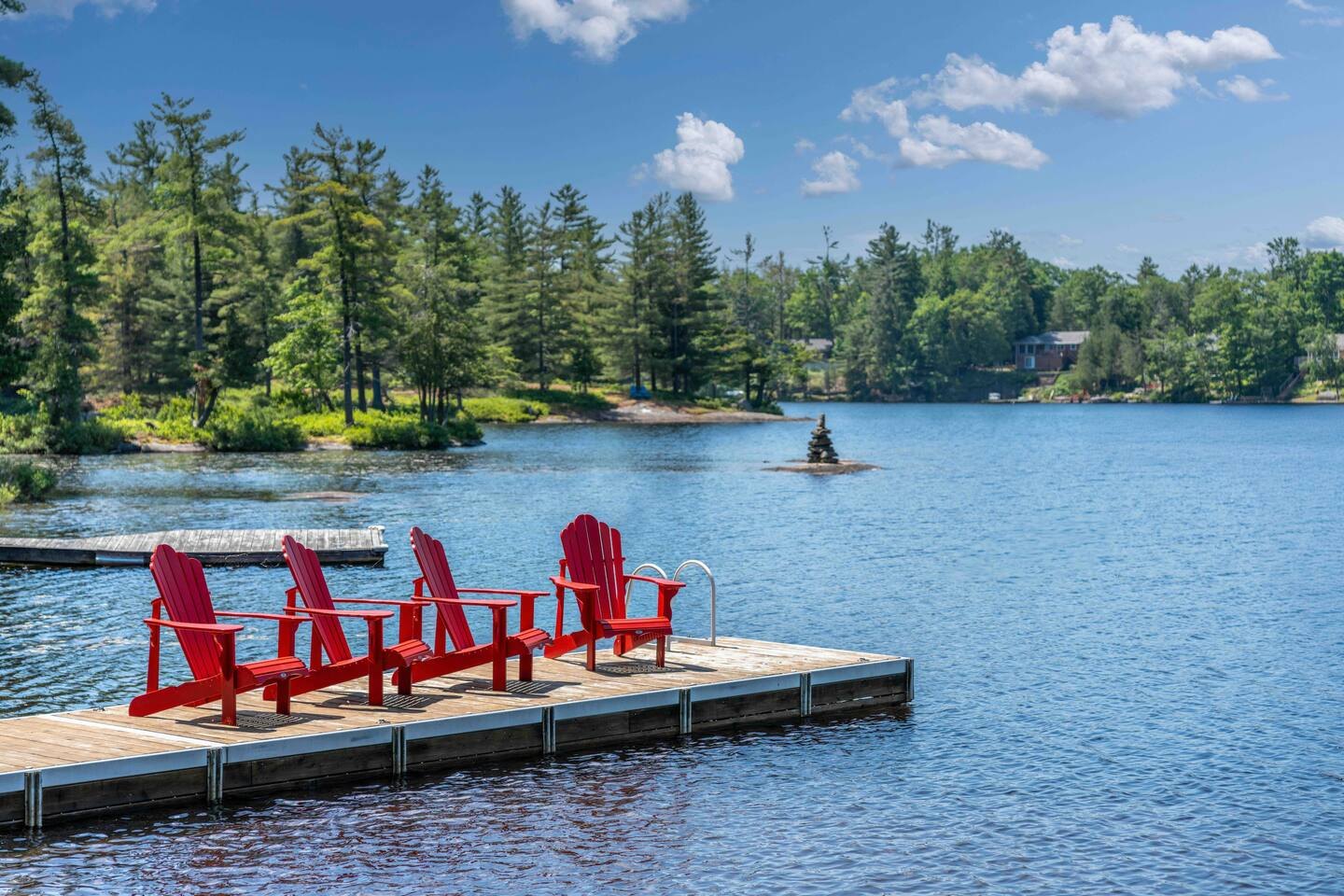
A cottage also works differently from a city home. Many owners rent it out for part of the year and keep weeks for their own family. Our guide to how you can rent out your cottage and still use it shows how that can look, and our Leonard Lake cottage rental management and Bracebridge cottage management pages show what we do around Bracebridge.
Mississauga short-term rental licence: quick answers
Can I get a Mississauga short-term rental licence for a second property?
No. The City says the licence can't be issued for additional or investment properties. It is only for your principal residence.
How long can a guest stay?
Each stay can be up to 30 days in a row. You can rent your home for up to 180 days a year in total.
Can I list my home on Airbnb while I wait for the licence?
No. The operator's guide says you must get the licence before you advertise or host guests, and your licence number goes on every ad.
Do I need to be there when the City visits?
Yes. The operator's guide says you have to attend, and another person can't attend on your behalf.
Start with the slow step
If your trip is a few months away, the best thing you can do today is order the Peel Regional Police check. Everything else fits around it. Want to see what a well-run rental looks like up north? Browse the Homeseeker residences or our Huntsville cottage rental management page.
About this guide: licence rules, documents, the police check, insurance, the City visit, the fine and renewal timing are from the City of Mississauga's "Apply for a short-term rental accommodation licence" page. The one-rental limit, attending the visit, advertising, emergency contacts, the evacuation plan, records and MAT are from the City's 2026 short-term rental operator's guide. The licence number rule is from the City's operator resources page. All read November 19, 2026. This is general information, not legal advice. Check the City's pages before you apply, because rules and fees can change.


