
Toronto Short-Term Rental Tax: The MAT Report You Still File
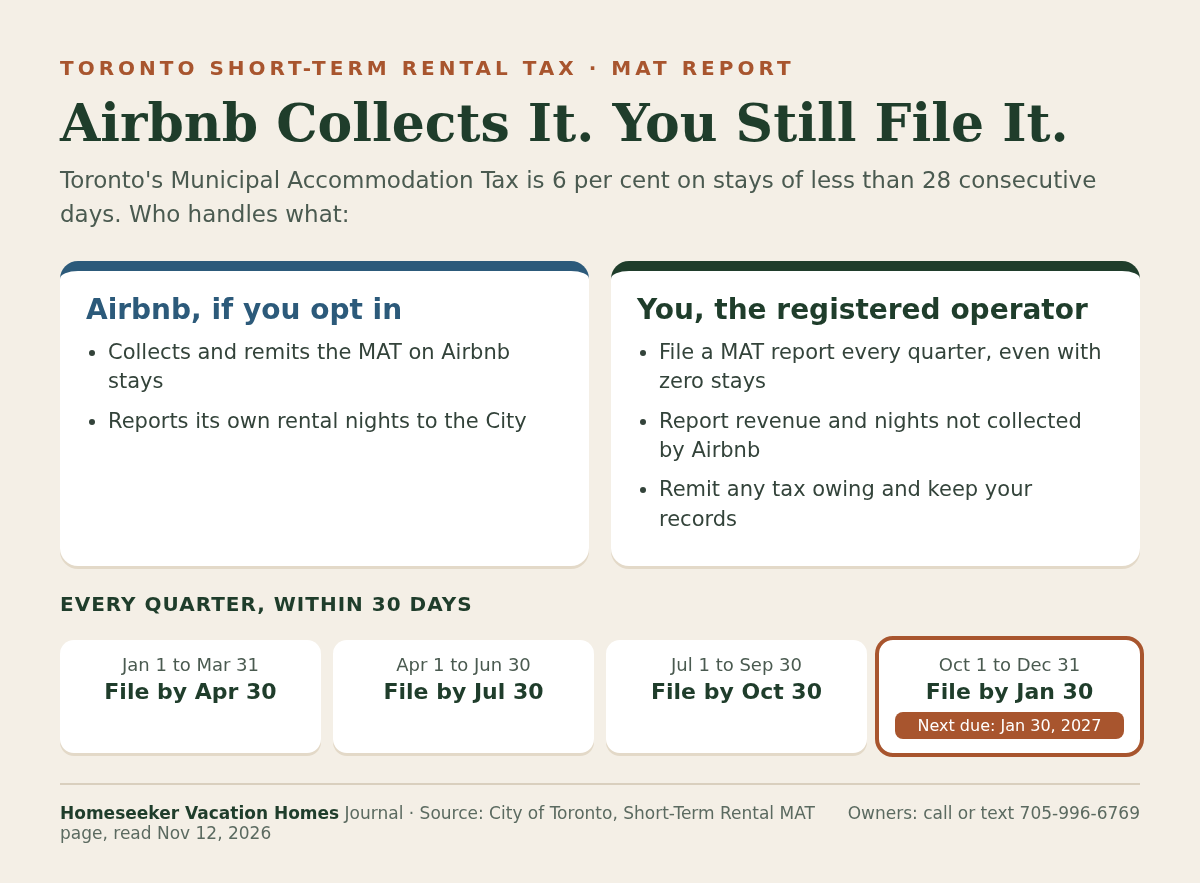
If you opted in, Airbnb collects Toronto's Municipal Accommodation Tax (MAT) on your Airbnb stays. The City of Toronto still expects a MAT report from you every quarter, even with zero stays. Here is what the report is and how to file it in five steps.
Why the City still wants a report from you
It's late January. The holidays are over, the last guests have checked out, and you're finally catching up on paperwork.
You opted in to have Airbnb collect Toronto's short-term rental tax, so it was added to your Airbnb stays. You never touched it, so you might think you can skip this part.
The Toronto short-term rental tax is collected one way and reported another. And the reporting part has your name on it, not Airbnb's.
What Toronto's short-term rental tax covers
The tax is the Municipal Accommodation Tax, or MAT. According to the City of Toronto's MAT page, the temporary increase to 8.5 per cent ended on August 1, 2026. The rate is now 6 per cent, on stays beginning August 1, 2026.
The City's operator page says the MAT applies to all rentals of less than 28 consecutive days. That is the same line the City uses to define a short-term rental.
Toronto allows short-term rentals only in your principal residence, and registration is required before you rent.
Short-term rental companies can sign a Voluntary Collection Agreement with the City and collect the MAT for you. The City's MAT page names Airbnb as one you can opt in with. Its page for rental companies says that if a company doesn't sign one, you collect and remit the MAT yourself.

Three ways owners miss the MAT report
Here are three easy ways to miss the report.
1. Skipping a quarter because nothing happened
The City says you must file a MAT report for every reporting period, including a quarter with no rentals and a quarter where Airbnb collected the tax. A quiet winter quarter still needs a report.
2. Forgetting the stays that didn't come through Airbnb
Airbnb reports its own nights to the City. Everything else is on you. A stay through Vrbo, or a repeat guest who came back another way, belongs on your report. If you list on more than one site, confirm with each one whether it collects the MAT in Toronto.
3. Treating a late report as a small problem
It can cost you more than money. The City says it may revoke your short-term rental registration, or deny its renewal, if you fail to file and remit the MAT. Interest on overdue tax also starts the day after the due date, at a monthly rate of 1.25 per cent.
What the MAT report does
You do not pay again the tax Airbnb collected. You report the revenue and nights Airbnb did not collect.
Airbnb tells the City about Airbnb stays. You tell the City about everything else. Some quarters that means remitting tax. Some quarters it means filing a report that says nothing was owed.
The one-line rule: Airbnb can collect the tax. Only you can file the report. Every quarter, even when the house sat empty.
How to file your Toronto MAT report in 5 steps
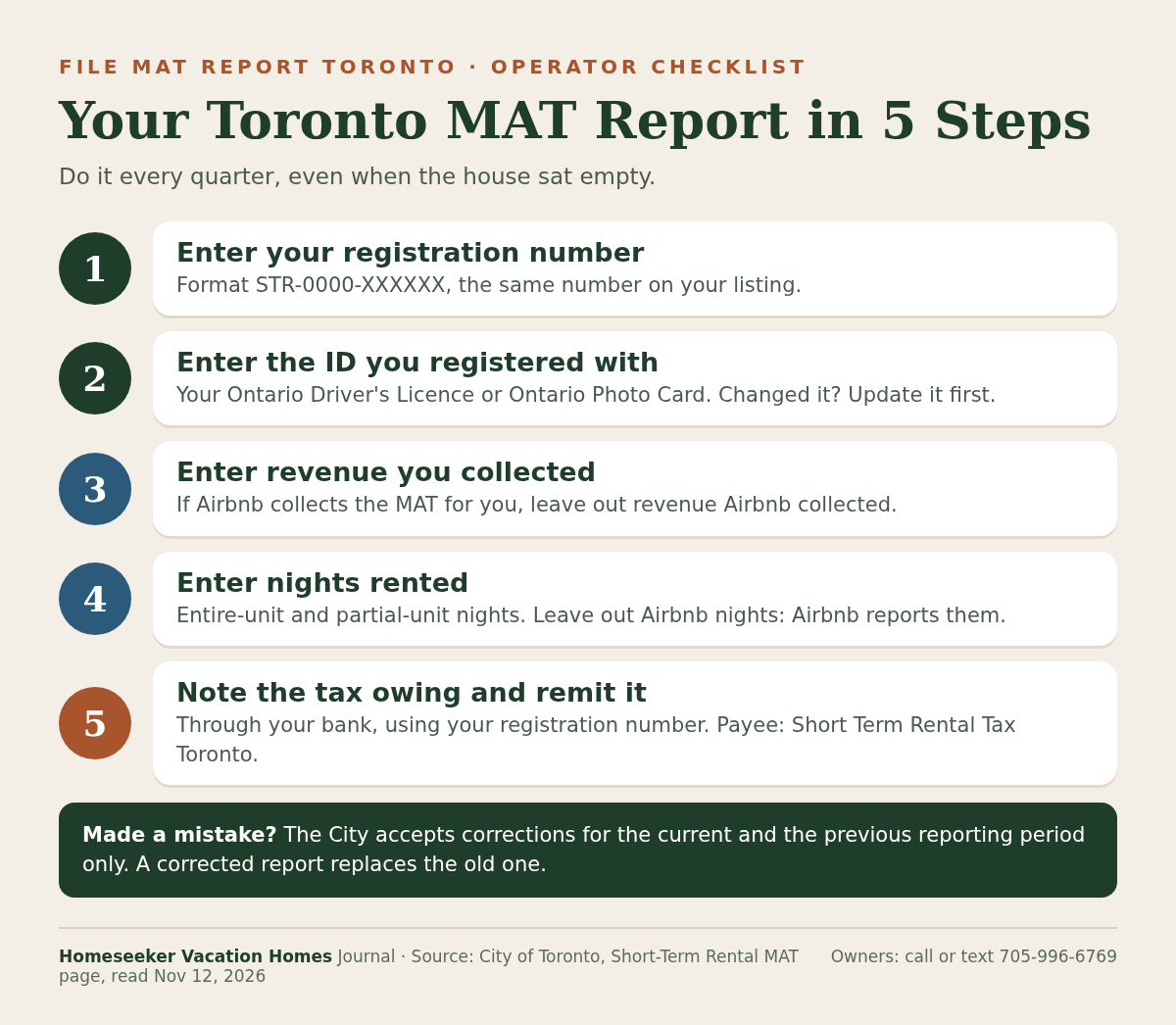
Step 1: Enter your registration number
It's the City-issued number in the format STR-0000-XXXXXX, the same one that has to appear on your listing. Our guide on how to check a Toronto Airbnb registration number shows where guests look for it.
Step 2: Enter the ID you registered with
That's your Ontario Driver's Licence or Ontario Photo Card. If your ID changed after you registered, the City asks you to update it before you file.
Step 3: Enter the revenue you collected
If Airbnb collects and remits the MAT for you, leave out the revenue Airbnb collected. Include stays from anywhere else.
Step 4: Enter the nights you rented
Count entire-unit and partial-unit nights for the period. Leave out Airbnb nights, because Airbnb reports those to the City directly.
Step 5: Note the tax owing and remit it
The report works out what you owe. You remit it through your bank using your registration number, and the payee is Short Term Rental Tax Toronto. The City suggests sending it a few days before the due date.
Keep your records
The City asks operators to keep a record of every accommodation transaction. Its operator page lists the nights rented, the nightly and total price for each rental, and whether it was an entire-unit or partial-unit rental. Corrections are accepted only for the current and the previous reporting period, so a quick check each quarter beats a big cleanup later.
Thinking about longer stays this winter? Don't cancel in a hurry
Some city owners use their short-stay nights in the busy months and look at stays of 28 days or more the rest of the year. Toronto caps entire-unit short-term rentals at 180 nights per calendar year, so that mix can make sense.
If you're tempted to cancel your registration for the winter, read the City's fine print first. Once a registration is cancelled, no new short-term rental registration is allowed at that property for one year. You also stay responsible for remitting MAT until the cancellation goes through. A longer stay has its own rules too, so have your lawyer review that agreement.
Want to talk through a Toronto calendar that mixes short stays and longer ones? Call or text 705-996-6769 and we'll walk through it with you. You can also read how our Toronto Airbnb management works.
Toronto MAT report: quick answers
Do I file a MAT report if Airbnb collects the tax?
Yes. The City of Toronto says you file for every reporting period even if a short-term rental company collected the MAT for you.
When is the next Toronto MAT report due?
The October 1 to December 31 period is due January 30, so the next one is due January 30, 2027. January 30, 2027 is a Saturday, so aim to file the week before. The other due dates are April 30, July 30 and October 30.
What is the Toronto MAT rate now?
6 per cent on stays beginning August 1, 2026, after the temporary 8.5 per cent rate ended, according to the City.
Do I file if my home wasn't rented this quarter?
Yes. The City says you file even if you did not rent out your short-term rental that period.
Does Harmonized Sales Tax (HST) apply to the MAT?
Only if you are registered for Harmonized Sales Tax (HST) as a short-term rental operator, according to the City. Our guide to Airbnb taxes in Ontario covers HST and income tax in more detail.
Where we help owners
In the city, we help owners in Toronto and across the Greater Toronto Area plan their calendar around the City's rules. In cottage country, we offer Muskoka cottage rental management and work with owners in Parry Sound cottage rental management, Georgian Bay cottage rental management and Lake Simcoe cottage rental management. Owners and guests give us 4.9 stars across 100 Google reviews.
Own a cottage too? Keep the Ontario cottage rental HST and tax guide handy, and see our owner's winter plan for monthly cottage rentals.
About this guide: MAT rate, due dates, filing steps, interest, HST and Airbnb reporting are from the City of Toronto's Short-Term Rental Municipal Accommodation Tax page, read November 12, 2026. The 28-day line, principal-residence rule, registration requirement, 180-night limit, record keeping and cancellation rules are from the City's Short-Term Rental Operators/Hosts page, read November 12, 2026. Collection agreements are from the City's Short-Term Rental Companies page, read November 12, 2026. The City lists [email protected] on its MAT Audit, Dispute Resolution and Refunds page, read November 12, 2026. This is general information, not tax or legal advice; confirm details with the City at [email protected] or with your accountant.


